Battery storage is the component that transforms a solar array from a daylight-only power source into a system capable of running loads through the night and across multiple overcast days. Sizing the battery bank correctly — not too small to cover demand, not so large that the panels cannot recharge it in reasonable conditions — is one of the more consequential design decisions in an off-grid system.
Battery chemistries in common use
Flooded lead-acid (FLA)
The oldest rechargeable battery technology in widespread use, flooded lead-acid batteries consist of lead plates submerged in liquid sulphuric acid electrolyte. They are the least expensive option per ampere-hour of capacity and are straightforward to maintain. The tradeoffs are significant: they must be kept upright, they require periodic electrolyte top-up with distilled water, they off-gas hydrogen during charging (necessitating ventilated enclosures), and their usable capacity is limited to approximately 50% of rated capacity to avoid damaging deep discharge.
In cold Canadian winters, FLA batteries lose capacity. At −20°C, a flooded lead-acid battery may retain only 50–60% of its room-temperature capacity. This seasonal derating must be factored into sizing for year-round use.
Absorbed glass mat (AGM)
AGM batteries use a fibreglass mat separator to absorb and immobilise the electrolyte, making them sealed, spill-proof, and installable in any orientation. They can be charged faster than FLA, accept higher charge currents, and lose capacity at low temperatures somewhat less severely. Their cost is higher than FLA; their usable depth of discharge is similar, at around 50%.
For cabin installations where the battery compartment may not be perfectly ventilated or temperature-controlled, AGM is a practical middle ground between FLA and lithium chemistries.
Lithium iron phosphate (LiFePO4)
Lithium iron phosphate batteries have substantially higher usable capacity — typically 80–90% depth of discharge without accelerated degradation — and a much longer cycle life than lead-acid chemistries. A well-maintained LiFePO4 bank may complete 2,000–3,000 cycles before capacity degrades to 80% of original; lead-acid banks rated at 50% DoD often reach 500–700 cycles.
The practical consequence is that a lithium bank typically costs more per kWh of installed capacity, but less per kWh of delivered energy over the life of the system. The other significant consideration is cold charging: lithium iron phosphate cells must not be charged below 0°C, as lithium plating on the anode causes permanent damage. Quality LiFePO4 battery management systems (BMS) include low-temperature charge cutoff. For unheated cabin battery enclosures in northern Canada, this protection is not optional.
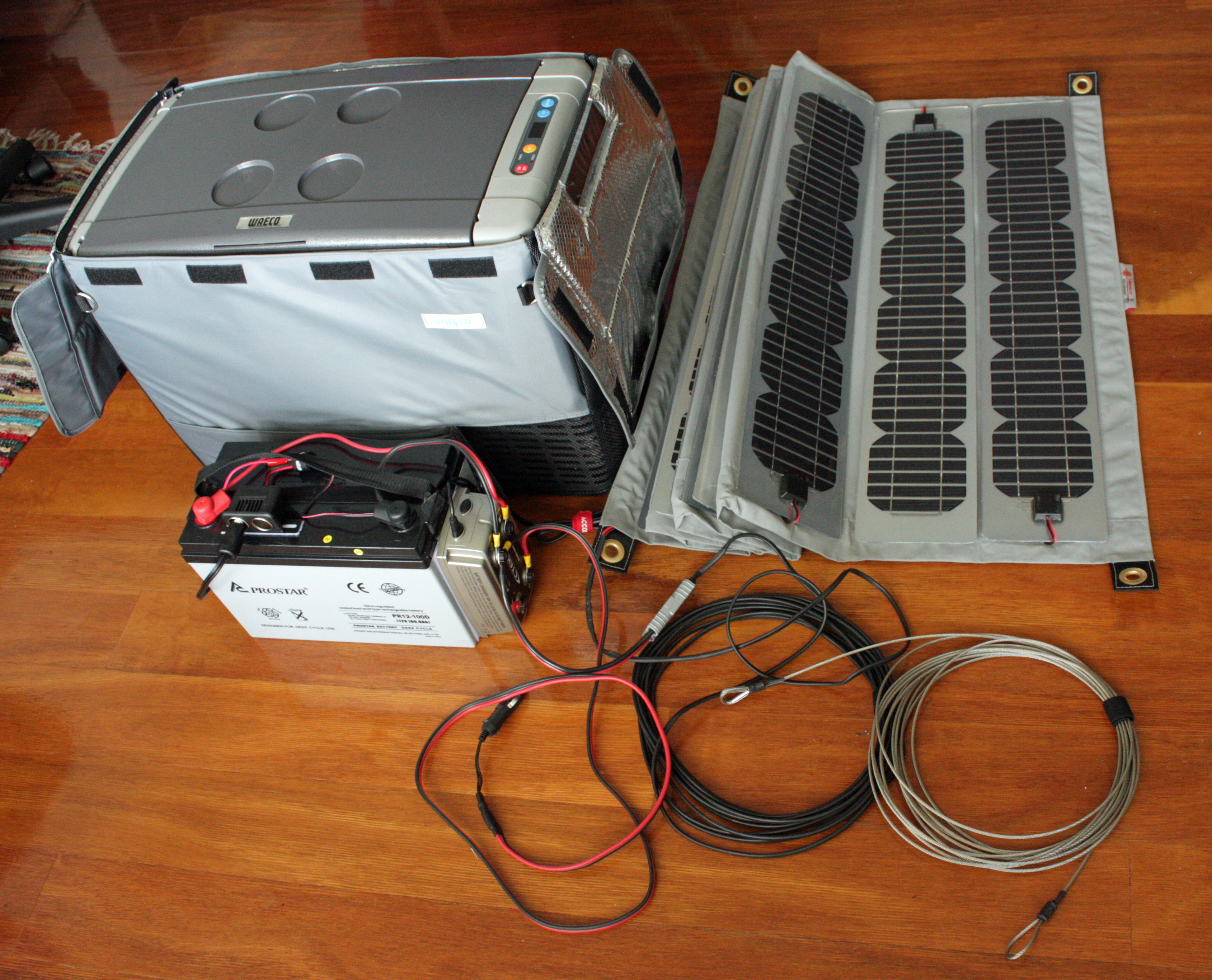
Calculating battery bank capacity
The starting point is a daily load estimate in watt-hours. This requires listing every load — LED lighting, water pump, refrigerator, communications equipment, laptop chargers — and multiplying wattage by estimated hours of use per day. The sum is the baseline daily demand.
The bank must cover that demand for the number of autonomy days the design targets. Two to three days of autonomy is common for a cabin without a backup generator; more is appropriate in regions with extended overcast periods.
The calculation, accounting for usable depth of discharge and battery efficiency, is:
Required capacity (Ah) = (Daily load Wh × Autonomy days) / (System voltage × DoD × Battery efficiency)
Worked example
A cabin with a 600 Wh/day load, 3 days autonomy, 24V system, 50% DoD (lead-acid), and 85% battery efficiency needs: (600 × 3) / (24 × 0.50 × 0.85) = 1,800 / 10.2 ≈ 177 Ah at 24V. In practice, a 200 Ah bank at 24V would be specified. With LiFePO4 at 85% DoD: (600 × 3) / (24 × 0.85 × 0.95) ≈ 98 Ah — roughly half the physical size for equivalent usable storage.
Panel sizing to recharge the bank
The array must be able to replenish the battery bank's daily discharge plus system losses within the available peak sun hours. Natural Resources Canada's PV potential data shows December averages below 2 peak sun hours per day at latitudes above 55°N. A system sized only for July will run out of stored energy by January.
| Location | December PSH | June PSH | Annual Average PSH |
|---|---|---|---|
| Vancouver, BC | ~1.5 | ~5.5 | ~3.4 |
| Ottawa, ON | ~2.0 | ~5.8 | ~3.7 |
| Whitehorse, YT | ~0.9 | ~6.2 | ~3.0 |
| Calgary, AB | ~2.4 | ~6.0 | ~4.0 |
PSH = peak sun hours. Values are approximate averages from Natural Resources Canada photovoltaic mapping data.
Panel sizing uses the worst-case monthly PSH for the design location. The formula:
Array size (W) = Daily load (Wh) / (PSH × system efficiency × derating factor)
System efficiency accounts for charge controller losses (typically 3–7%), wiring losses (target <3%), and battery charge/discharge round-trip efficiency. A combined derating of 0.75–0.80 is a commonly applied conservative factor for a complete system.
Temperature derating for batteries in Canadian winters
Lead-acid capacity at various temperatures, relative to rated capacity at 25°C:
| Temperature | Approximate Capacity Retention (Lead-Acid) |
|---|---|
| 25°C | 100% |
| 10°C | ~88% |
| 0°C | ~78% |
| −10°C | ~64% |
| −20°C | ~50% |
For unheated battery enclosures in northern Canada, this derating can nearly halve usable capacity. Insulated, partially heated battery boxes — or the selection of LiFePO4 with thermal management — address this limitation.
State of charge monitoring
Reliable state-of-charge (SoC) monitoring is essential for protecting battery longevity. A battery monitor — also called a coulomb counter — tracks cumulative charge in and out of the bank, providing a more accurate SoC reading than voltage alone, which varies with temperature and load. Most MPPT charge controllers include basic voltage-based monitoring; a dedicated battery monitor on the main shunt provides more accurate data for managing the bank over time.
Generator backup
Many off-grid cabin systems include a small generator to supplement solar during extended low-sun periods. A good charge controller or inverter/charger will accept the generator's AC output and use it to recharge the battery bank. This adds redundancy without requiring the solar array to be sized for the absolute worst-case weather scenario, which would otherwise produce significant excess capacity in summer.
For further reference on off-grid solar system design, Natural Resources Canada's solar energy resources provide location-specific irradiance data and design guidance applicable to Canadian installations.

