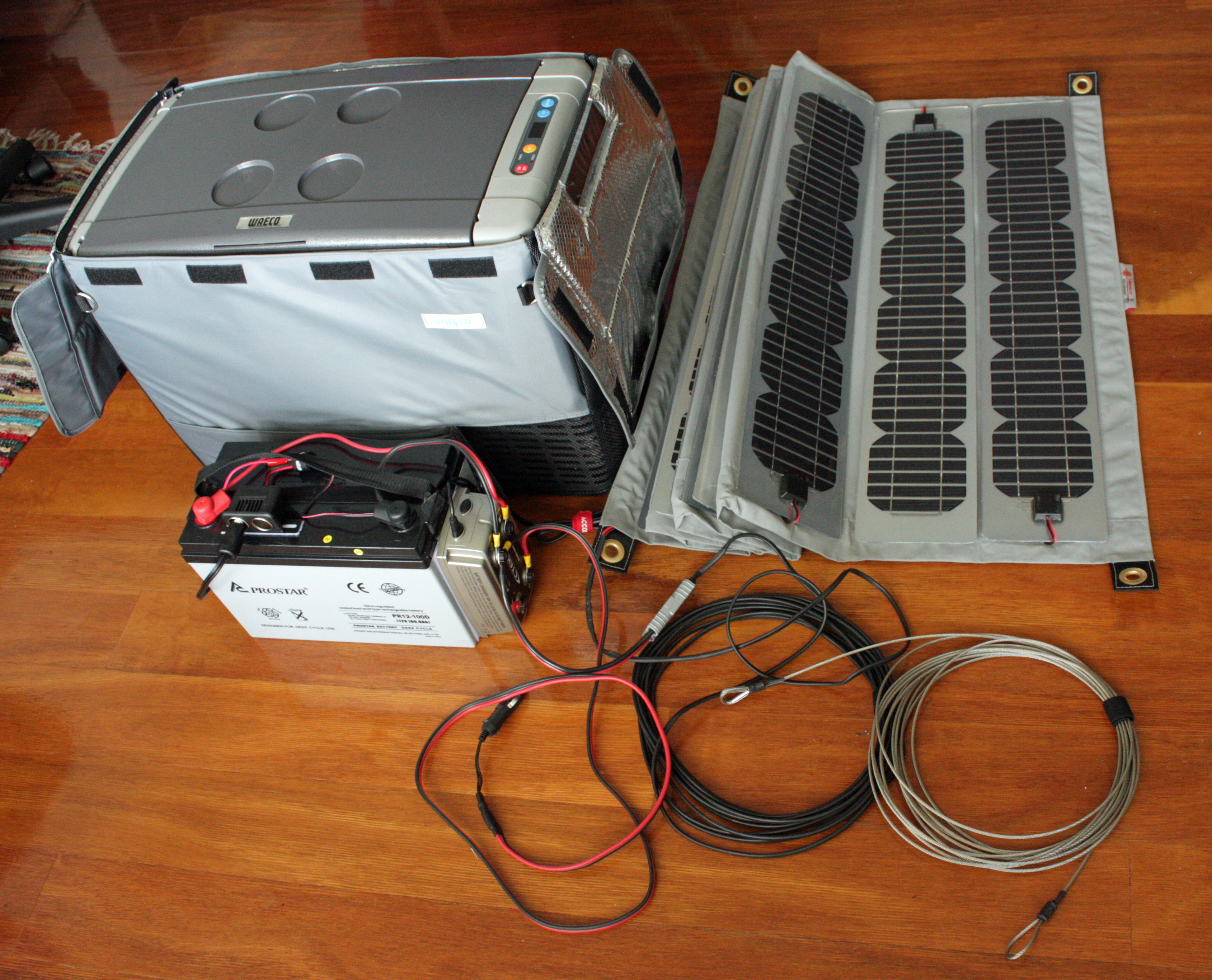
Selecting a solar panel for a remote cabin is not the same exercise as selecting one for a grid-tied suburban roof. Off-grid systems carry no safety net: if the panels do not produce enough energy on a given day, the battery bank depletes and loads go offline. The choice of panel technology, wattage, and quantity has direct consequences for how a cabin operates through a Canadian winter.
The three main panel technologies
Modern photovoltaic panels available to Canadian consumers fall into three broad categories, each built around a different silicon structure. Their differences in manufacturing process translate into measurable differences in performance, physical size, and cost per watt.
Monocrystalline panels
Cut from a single silicon crystal, monocrystalline cells produce the highest conversion efficiency of the three types — typically between 19% and 23% in current commercially available panels. The high efficiency means a smaller physical footprint is needed for a given power output, which matters when roof area or ground space at a cabin site is constrained.
In cold conditions, monocrystalline panels have a slight advantage. Silicon conductivity improves marginally at lower temperatures, and most monocrystalline panels carry a lower temperature coefficient than polycrystalline alternatives. The practical effect on a February day in northern Ontario is modest but real: a panel rated at 400 W at 25°C may produce slightly more than its nominal rating at −10°C, assuming sufficient irradiance.
Temperature Coefficient
Most crystalline silicon panels lose approximately 0.3–0.45% of their rated output for each degree Celsius above the Standard Test Condition temperature of 25°C. On a hot summer afternoon when roof-mounted panels can reach 60°C or more, actual output may be 15–20% below the nameplate rating.
Polycrystalline panels
Produced by melting silicon fragments together rather than growing a single crystal, polycrystalline panels have a distinctive blue, speckled appearance. Their efficiency runs roughly 15–18%, meaning a larger physical panel is required to deliver the same wattage as a monocrystalline unit. The manufacturing process is simpler and historically produced lower-cost panels, though the price gap between technologies has narrowed considerably in recent years.
For a cabin with abundant unshaded roof or ground area, polycrystalline panels remain a practical option. Their lower efficiency is less of a constraint when physical space is not the limiting factor.
Thin-film panels
Thin-film technology deposits photovoltaic material — typically cadmium telluride (CdTe) or copper indium gallium selenide (CIGS) — onto glass or flexible substrates. Efficiency ranges from around 10% to 18% depending on the specific chemistry. The key advantage of thin-film is low-light performance: some formulations maintain a higher fraction of their rated output under diffuse or overcast sky conditions compared to crystalline silicon.
For cabin applications, thin-film panels on rigid glass substrates are bulky relative to their wattage. Flexible thin-film products designed for marine and RV use are sometimes applied to off-grid structures with unconventional roof profiles, though their durability in freeze-thaw cycles and under snow load warrants careful evaluation of manufacturer specifications.

Wattage and array sizing
A cabin's daily energy demand — expressed in watt-hours — determines the minimum array size. The calculation requires knowing three things: the total load in watt-hours per day, the number of peak sun hours at the site, and the combined efficiency losses of the charge controller, wiring, and battery charge/discharge cycle.
Natural Resources Canada's photovoltaic potential mapping tool provides monthly average peak sun hours for locations across Canada. A site in the Yukon may see fewer than 2 peak sun hours per day in December; the same site may see 6 or more in June. Sizing against the winter minimum ensures the system can sustain loads year-round.
| Panel Type | Typical Efficiency | Low-Light Performance | Cold Tolerance | Common Use |
|---|---|---|---|---|
| Monocrystalline | 19–23% | Moderate | Good | Space-constrained roof mounts |
| Polycrystalline | 15–18% | Moderate | Good | Open ground mounts |
| Thin-film (CdTe/CIGS) | 10–18% | Better in diffuse light | Varies by substrate | Flexible or non-standard surfaces |
Mounting and orientation
In Canada, fixed south-facing panels mounted at an angle approximately equal to the site's latitude capture the most energy over a full year. Steeper winter angles (latitude plus 15°) favour December output at the expense of summer production. For a cabin used primarily in winter, this trade-off may be appropriate.
Snow accumulation on low-angle panels is a practical concern across most of Canada. Mounting at 45° or steeper allows snow to slide off more readily. Ground-mount frames also allow easier manual clearing than roof-mounted systems on steep pitches.
Panel connections and string design
Panels can be wired in series, parallel, or a combination of both. Series wiring increases voltage while keeping current constant; parallel wiring increases current while keeping voltage constant. The target output voltage must match the charge controller's input range and the battery bank's nominal voltage. Most small cabin systems operate at 12V, 24V, or 48V DC. Higher voltages allow longer wire runs with less loss and are increasingly common in systems above 1 kW.
Shading and bypass diodes
A single shaded cell in a series string can reduce the output of the entire string significantly. Quality panels include bypass diodes that route current around shaded sections. For cabin installations surrounded by trees, the shading analysis at different sun angles throughout the day is an important part of siting.
Canadian standards and labelling
Panels sold in Canada should carry CSA or ULC certification, or equivalent IEC 61215 and IEC 61730 certifications recognised by Canadian authorities. These standards cover mechanical load ratings — relevant to snow load in Canadian climates — as well as electrical safety under fault conditions. The Canadian Electrical Code, Part I, Section 64 governs photovoltaic systems and references these standards.
For further technical reference, Natural Resources Canada's residential energy efficiency resources include guidance on solar installations in Canadian climates.