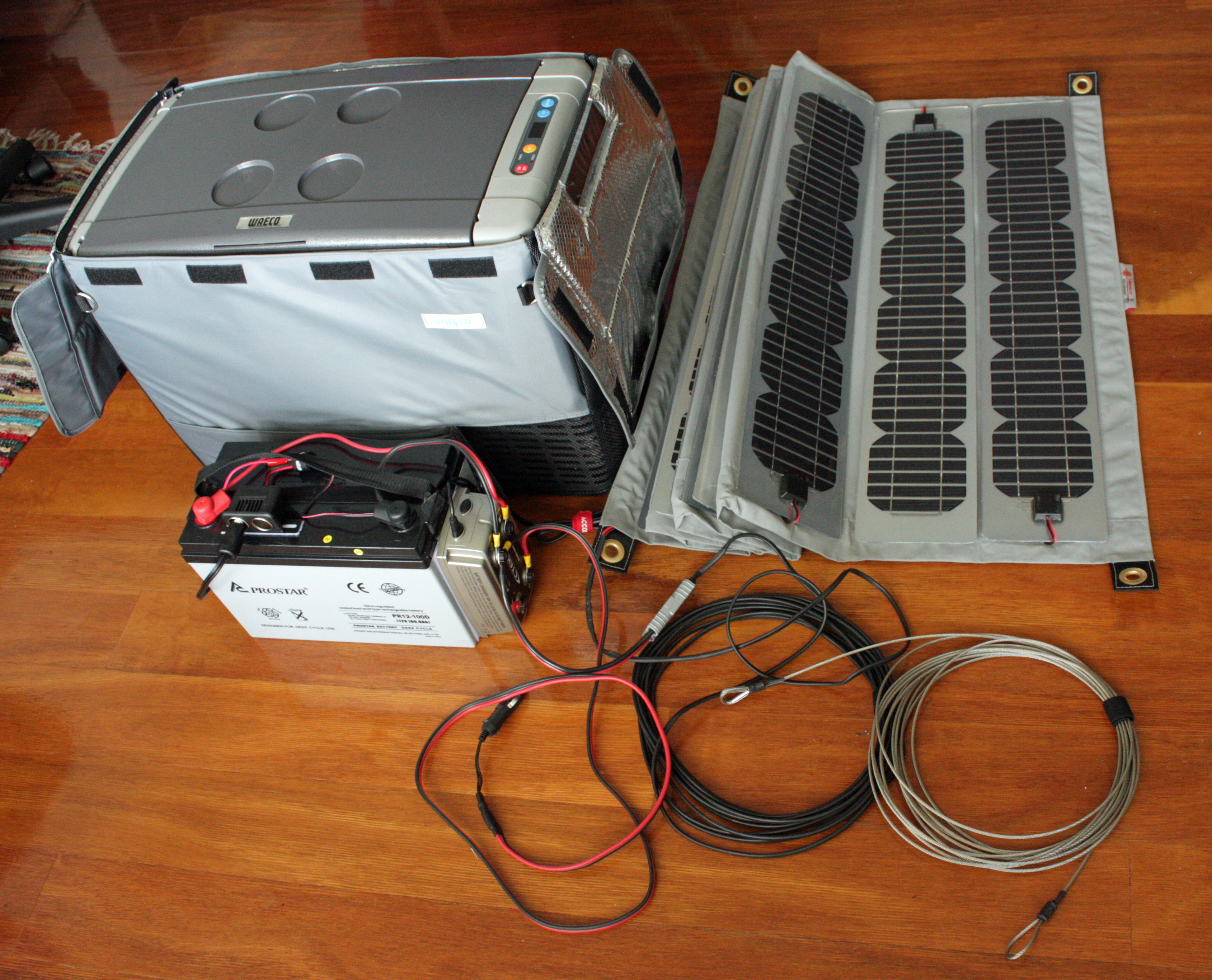
The panels produce power, but it is the wiring and balance-of-system components that determine whether that power reaches loads safely and efficiently. An undersized conductor generates heat and voltage drop. A missing fuse or disconnect leaves the system without fault protection. Understanding each component's function and its placement in the circuit is a prerequisite for any off-grid installation — and a requirement under the Canadian Electrical Code.
System voltage: 12V, 24V, or 48V
Most small cabin systems operate at a nominal DC bus voltage of 12V, 24V, or 48V. The choice affects every other component. Higher bus voltages allow the same power to travel through smaller-gauge wire with less resistive loss — a significant consideration when the charge controller is mounted some distance from the battery bank. A 1,000 W system at 48V draws roughly 21 A; at 12V it would draw about 83 A, requiring considerably heavier wiring.
Systems below 500 W of panel capacity are often built at 12V for simplicity. Larger systems — 1 kW and above — generally favour 24V or 48V to keep wiring costs and losses manageable. The inverter and charge controller must both match the selected bus voltage.
Charge controllers
A charge controller sits between the panel array and the battery bank. It prevents overcharging, which shortens battery life, and on better units it prevents deep discharge by disconnecting loads when voltage drops below a threshold.
PWM controllers
Pulse-width modulation (PWM) controllers work by rapidly switching the connection between the panels and battery. As the battery approaches full charge, the duty cycle narrows and less current flows. PWM controllers are straightforward and inexpensive, but they are most efficient when the panel's rated voltage closely matches the battery bank's charging voltage. A 36-cell panel designed for 12V battery charging pairs well with a PWM controller; a higher-voltage panel string does not.
MPPT controllers
Maximum power point tracking (MPPT) controllers use a DC-DC converter to continuously adjust the electrical operating point of the panel string to extract the maximum available power, then step that power down to the battery voltage. The conversion efficiency of a quality MPPT controller runs 93–98%. In cold weather, when open-circuit voltage is elevated, an MPPT controller can recover meaningfully more energy than a PWM unit from the same panel array. For most Canadian cabin applications with panels above 200 W, MPPT is the practical standard.

Fusing and overcurrent protection
Every conductor in the system requires overcurrent protection sized to protect the wire, not the load. The Canadian Electrical Code, Rule 64-212, specifies requirements for photovoltaic source circuit overcurrent protection. In practice, this means:
- Each panel string requires a fuse or breaker rated to 1.56 times the panel's short-circuit current, when two or more strings are connected in parallel.
- The main conductor between the array and charge controller requires protection at the array end.
- The battery bank requires a fuse or breaker as close to the positive terminal as physically possible — within 150 mm is typical practice — to protect against catastrophic fault current from the battery itself.
- The conductor between battery bank and inverter requires similarly close fusing, given that a battery bank can source thousands of amps under a dead short.
Battery fuse sizing
The fuse protecting the battery-to-inverter cable must be rated for the maximum continuous current the inverter draws, plus a margin, but must not exceed the ampacity of the cable. A 2,000 W inverter at 24V draws approximately 83 A at full load; a 2/0 AWG cable has an ampacity well above this, and a 150 A ANL fuse is typical for this configuration.
DC disconnects
The CEC requires means of disconnecting the PV source circuit, the charge controller, and the battery bank for maintenance and emergency shutoff. A dedicated DC-rated disconnect switch — not an AC breaker used in a DC circuit — must be used, as DC arcs behave differently from AC arcs when interrupting current. Many charge controllers include built-in disconnect capability; dedicated battery disconnect switches are also common.
Inverters
An inverter converts the DC voltage of the battery bank to 120V AC (60 Hz in Canada) for standard household loads. Two types are sold for off-grid use:
Pure sine wave inverters
Pure sine wave inverters produce an AC waveform that closely matches the utility grid output. All AC loads — motors, compressors, audio equipment, electronics with switching power supplies — operate correctly from a pure sine wave. Most new off-grid installations use pure sine wave units despite their higher cost.
Modified sine wave inverters
Modified sine wave inverters produce a stepped approximation of a sine wave. They are less expensive but incompatible with some loads: certain motor types run hotter and less efficiently, some battery chargers behave unexpectedly, and audio equipment may produce audible hum. For a cabin powering only resistive loads such as lighting, modified sine wave units can be a lower-cost option.

Wiring gauge and voltage drop
The Canadian Electrical Code uses the CSA ampacity tables to determine minimum wire gauge. For DC circuits, voltage drop is the additional constraint: a drop exceeding 3% between the panel array and charge controller, or between the battery bank and inverter, represents a meaningful efficiency loss. The standard voltage drop formula is:
Drop (V) = 2 × Length (m) × Current (A) × Resistivity / Cross-section (mm²)
In practical terms, the cable run from a battery bank to an inverter should be as short as possible — often less than 1 metre — using large-gauge cable to minimise resistance and the associated heat and voltage loss.
| AWG / mm² | Ampacity (60°C) | Typical Use in Off-Grid Systems |
|---|---|---|
| 10 AWG / 5.26 mm² | 30 A | Panel strings, small PWM controller output |
| 8 AWG / 8.37 mm² | 40 A | MPPT controller to battery, mid-range systems |
| 6 AWG / 13.3 mm² | 55 A | Battery bank connections, short runs to inverter |
| 2/0 AWG / 67.4 mm² | 195 A | Battery-to-inverter, large systems |
Grounding
Both the equipment grounding conductor (bonding metallic enclosures) and the grounding electrode conductor (connecting to earth ground) are required by the CEC for PV systems. A properly grounded system limits touch voltages during a fault and allows overcurrent devices to operate as intended. The grounding requirements for off-grid DC systems differ in some details from grid-tied systems; the authority having jurisdiction should be consulted before installation.
The full text of the Canadian Electrical Code Part I is available through the CSA Group. Section 64 covers photovoltaic systems in detail.